
My thoughts on: Woman on the Edge of Time
What does a true utopia look like in fiction? That simple question sent me down an internet rabbit hole that led me straight to Woman on the Edge of Time by Marge Piercy. First published in 1976, this seminal work of feminist science fiction is renowned for its radical vision of the future, yet it was a title I had completely missed until now.
What I discovered inside its pages was a profound, deeply challenging narrative that seamlessly bridges the gap between mid-century speculative fiction and today's modern conversations around gender, agency, and power structures. Fifty years after it was written, Piercy’s novel proves to be just as relevant, urgent, and mind-blowing as it was the day it hit the shelves.
Disclaimer: This post contains affiliate links to Bookshop.org. If you buy a book through these links, I earn a small commission at no extra cost to you, which helps support my writing and independent bookshops.
The Search for a True Utopia
My journey of finding this book didn’t take the path you might think it did. First published May 1976 it is renowned as a feminist science fiction novel, I would expect to be all the introduction that I needed to be drawn to this book. But I had never heard of it!
I came across it following a thought process that sent me in search of books of ‘pastoral utopia’. Having just finished reading Fahrenheit 451 I spent a lot of time contemplating how the view of dystopia has changed since the 1950s. Fahrenheit 451 is set in a middle class USA, where everyone lives comfortably, no one is worrying where their next meal comes from, everyone has a comfortable home, entertainment, a social circle, a car… it seems to me very quaint and old fashioned set of expectations nowadays. I can’t think of a dystopia that’s been written since that offers these things.
Thinking about dystopia, I realised I have no experience of the opposite. I’ve never read a true utopian novel. The closest is Aldous Huxley’s Brave New World, but everyone who’s read this knows this isn’t a true utopia. So, what does a utopia look like in fiction?
I took to Google to find out!
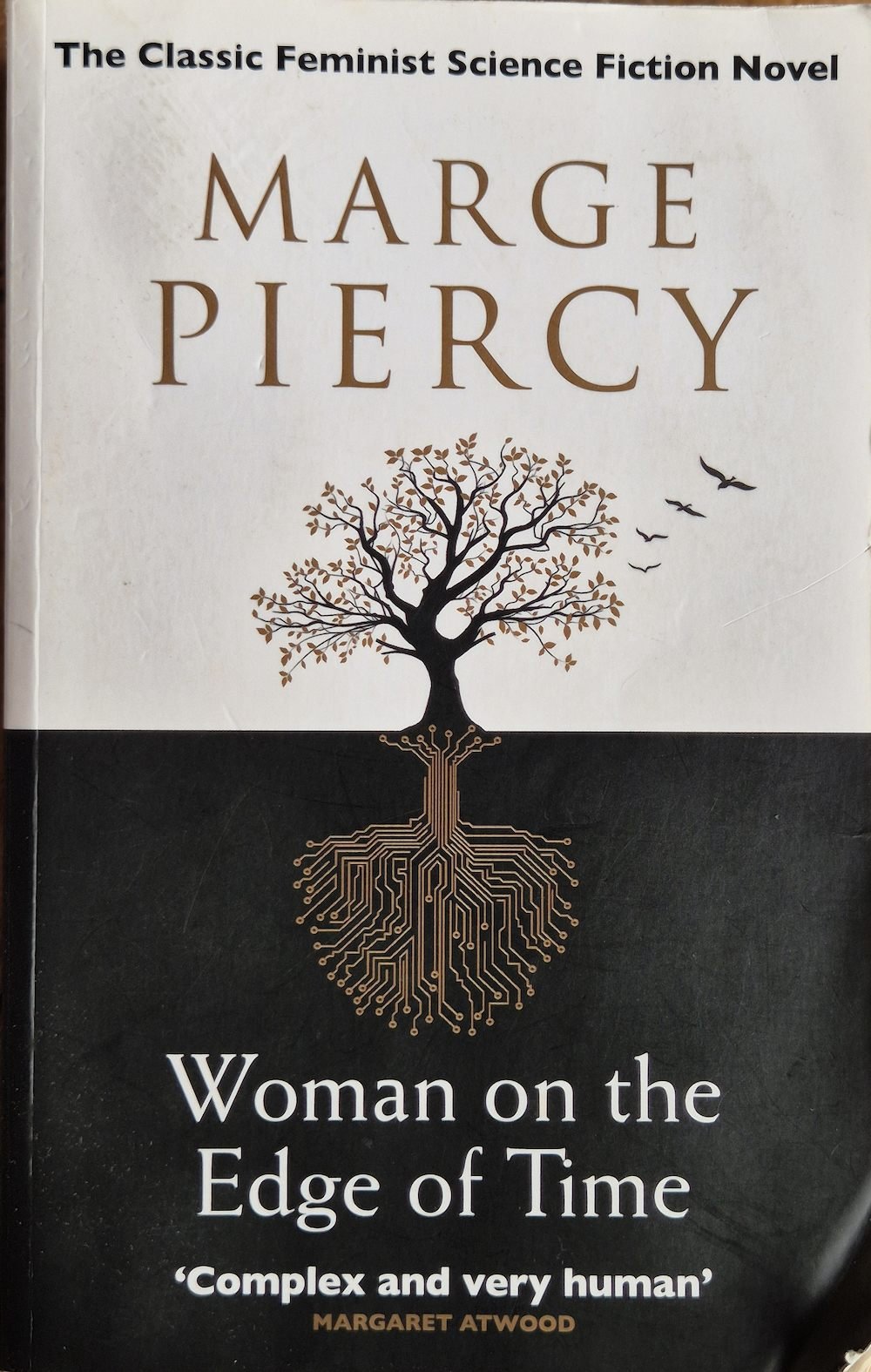
My copy of Woman on the Edge of Time.
(Photo: Rachel Foster)
Google presented me with a list of options, all of which sounded on point, but I was most interested in Woman on the Edge of Time because it was described a both a pastoral utopia and a future matriarchal society. It’s also one of the only entries on the list written by a woman. I had to start here.
It’s very rare that I would say a particular novel changed me but the experience of reading this had a profound impact. I aim to share some of this experience with you in this article.
The book was published in 1976 but from the very first paragraph I was struck by how timeless the setting was, the writing and the experiences of the novel’s protagonist, Connie. This book could have been written yesterday and would have looked exactly the same as these opening three pages after which I was hooked. A setting that isn’t unique within modern entertainment, the story opens with a woman maintaining her pride and dignity despite obvious poverty. Her female relative, abused and exploited by her male partner arrives seeking refuge.
Perhaps the only noticeable difference to a modern version of this situation is the lack of a mobile phone but even this quickly becomes irrelevant when Connie is committed, against her will, to a psychiatric hospital.
The main thread of the plot involves Connie being visited by a time traveler, Luciente, from the future. Hard sci-fi fans are likely to be frustrated that the exact mechanism for this time travel is never revealed being part of a conveniently secret project from the future, the time traveler themself is at pains not to reveal too much of this project. What we can discern is largely based on a psychic connection between Connie and Luciente, which over time Connie becomes more confident to exploit for herself and can initiate time travel for herself.
This explanation, while scientifically unsatisfying, for me highlights the insignificance of the time travel itself as the mechanism for allowing Connie and us to explore this alternative future.
There are two ways to interpret what’s really going on: is this really happening or is this a manifestation of Connie’s psychiatric condition.
The mysteriousness of the mechanism for time travel lends support to the argument that it is a symptom of psychosis. Although it is my opinion that this point does not need to be answered, it’s the vision of the future, the lessons we learn from it and the fragility of its permanence are all more important than if it is really real. It very much could be in the right circumstances.
I am quite disturbed by the number of people I’ve spoken to about this book who automatically dismiss everything in it as being just the rambling, drug-induced hallucinations of someone in a psychiatric ward. To dismiss somebody’s lived experience like this because of their mental health diagnosis is one of the fundamental prejudices that Piercy is trying to highlight to us.
When Connie is present in her real-time environment, we are bombarded with examples of how her agency is removed and how she is seen as lesser; not worthy of respect by her healthcare practitioners, carers, or her own family. I think we as audiences are challenged by this assumption: that her experience is meaningless, instead of examining the landscape that this book offers to consider an alternative possibility for all of our futures.
The fragility of this better future very much not set in stone and needs to be protected if it is to come to pass. This is just as true for our real lives as it is in the book.
We are shown this potential future by Luciente as she is guiding Connie around her home in Mattapoisett. I was starting to get very frustrated with the amount of show and tell exhibition going on in this section of the book, but it is important background, worth persevering with, as from this we learn interesting things about how this future is successful.
A Future Without Gender
The future Mattapoisett created balance between genders. It is not actually matriarchy, but a truly gender-neutral society. One possible term for this is Partnership Society which was a term popularised by Riane Eisler in 1987, more than a decade after Woman on the Edge of Time was published. A partnership society is defined as a system based on mutual respect, equity, and non-violence, serving as an alternative to the "dominator" (or domination) model characterized by rigid hierarchies, fear, and violence.
In 2026 we are more accepting of gender science and better general awareness that that biological sex is not binary, and gender is a construct of society. We also know that gender roles and expectations change depending upon where you live geographically and when you live in history. Woman on the Edge of Timeonly speaks of sex as male or female but does not discriminate on this and society does not expect men and women to behave differently based on their gender. One of the things I liked most about it is the default use of the pronoun “pers” to represent “person” rather than he, she or they.
All citizens of Mattapoisett are expected to contribute equally to the community regardless of sex. Marriage is also defunct, the very idea of ownership of any kind being fundamentally in opposition to both individuality/personhood and the collective needs of the community. For the same reason, society has become pan-sexual and polyamorous.
The Price of Equality
Piercy goes to some lengths to explain that this partnership society could only happen because humans intentionally gave-up childbearing as a human biological function replacing childbirth with technology , a point driven home when Luciente explains:
Finally, there was that one thing we had to give up too, the only power we ever had, in return for no more power for anyone. The original production: the power to give birth. Cause as long as we were biologically enchained, we'd never be equal.
This struck me as an incredibly profound tenet of the future: the recognition that the root of the patriarchal power structure is the repression of the child bearer. The patriarchy thrives on the inherent proposition that those who bear children cannot be seen as equal; therefore, to build true equality, no one should bear children.
The idea that, at some point in the future, humans could possess the profound emotional intelligence and insight to make this decision blew my mind. It is, I think, a decision of brave selflessness for the betterment of the many.
I am also struck that this is a society that sees the danger of genetic engineering. Technology is a useful tool that is deployed intentionally and used for the good of the collective. They intentionally avoid certain uses. For example, genetically modifying biological males to give them the option to bear children is not discussed. I believe doing so would have fundamentally contradicted the tenets of this society and made it less stable.
Reflecting on the modern rise of the 'manosphere,' incel culture, and organised misogyny, I wonder how much happier these men would be in a future like Mattapoisett. There is a sharp irony in the fact that it would be women’s selflessness, once again, that secures the happiness and peace of these men. Yet, when I consider the current rise in transphobia, I see how much safer trans and non-binary people would be in this future. In that light, the sacrifice of biological motherhood feels like a price worth paying.
Members of the community apply to become parents and always in groups of three adults of any sex, all parents are designated mothers. Mothering their shared child until the child comes of age at around 12 years old, when the child completes their naming ceremony and the bond with the mothers is broken. For me this is another significant component of the foundation of this society where individuals are granted full agency over their life and decisions. The breaking of the bond is the only way an individual can truly find themselves without perpetuating generational trauma or basing their choices on the expectations of their parents. I think about the harm caused in families as children grow into adults who struggle with maintaining relationships with their parents who may not be supportive of their lifestyle choices. In Woman on the Edge of Time children and parents are prevented from spending time together for 6 months following naming so they all have chance to reestablish the new rules of the relationship eventually welcoming each other back as equal members of the society.
Institutionalisation vs. Agency
Once we have completed the tour of Mattapoisett and learned about the structure of this society and its core beliefs, Connie begins to explore the world for herself and we see her beginning to change, have more self-confidence, greater agency, and she seems to develop more energy to fight for her own self-interest. We spend more time with Connie in real-time. We see also the degrading treatment of patients in the psychiatric ward by both staff and doctors at the hospital and their own families. It’s a reminder that when individuals are isolated, without support network, friends and people who believe in them there are few options for a person to thrive. Psychiatric patients are not treated as human in many ways, the politics of the psychiatric ward runs on different rules, patients must learn to play the game if they are to survive. It reminds me of the film The Shawshank Redemption in a lot of ways. Both share a backdrop of the effects of institutionalization and long-term incarceration.
This is a stark contrast to Mattapoisett where individuality is a core tenet of society, persons are given agency over their own decisions, no one is made to do anything. Everything is optional however contribution is expected. Individuals who do not choose to work towards the benefit of the collective slip out of society and stop benefiting from the collective effort. This is not socialism in the way described by George Orwell in Animal Farmwhere a few profits from the effort of the many. In Mattapoisett failure to contribute inherently generates no reward.
At the same time individuals are encouraged to find self-expression. Opportunities to indulge interests are built into the structure of society. A person picks their own name and is allowed to try on several names until they find the one that fits them best. While there are times when this is said to be frustrating, such as with the character Jackrabbit, it’s understood to be a process for the development of self, so no one is ever prevented. And so, society is self-maintaining because individuals being given the space and time to indulge in their own interests is a benefit of contribution to the needs of the collective. Time spent farming, mothering, in military service are all components that lead to the rewards of the individual.
I would go so far as to say that Piercy manages to find a solution to almost every problem in society: misogyny, patriarchy, capitalism, exploitation of the natural world are problems not faced in Mattapoisett with perfectly sound explanations of how these challenges were overcome and how the change benefited everyone. Google was wrong on one point when it recommended Woman on the Edge of Time, this isn’t a matriarchy society, and I am not convinced it’s truly pastoral in the sense that I was looking for when I started this journey. In Mattapoisett future, the political structure is one of direct democracy (a political system where citizens make laws and policy decisions directly, rather than electing representatives to act on their behalf) with universal suffrage and true gender equality. It is pastoral only because each community is working towards self-sufficiency and food security (the word they use in Mattapoisett to describe this is “ownfed”) and they operate with respect for nature, understanding exploitation of the land threatens their food security.
There is such a lot of subject matter covered in this novel. It is at times overwhelming and mind-blowing. Just as I got used to one thing I am hit with the next. I fully understand why this has been acclaimed as a seminal work of science fiction. Fifty years after it was written, despite how much has changed, this novel still has so much to teach me. It is just as relevant today as it was in 1976. I am nowhere near done thinking about this. I will read it again one day for sure.
The Utopia Reading Project Masterlist
If you would like to read along with me as I work my way through the Utopia Reading List, this is the exact collection of utopian novels that Google surfaced during my search for a perfect fictional world. It spans centuries of speculative thinking, tracking how writers have imagined the ideal society, and it is the very list that introduced me to Marge Piercy.
The interactive bookcase below is hosted directly on Bookshop.org. If you choose to buy any copies or browse through this list, you will be supporting independent bookshops and as an affiliate, I earn a small commission from purchases made through these links at no extra cost to you!
